It was almost midnight and I was still on my laptop, rewriting a client’s article for the third time.
The brief was simple. It always is. But the draft kept coming back flat. I had already used AI to speed things up, and the output sounded like every other article on the internet. The client noticed it too — “can you make this sound more like a person?”
I almost closed the laptop and quit freelance writing that night. Instead, I changed how I used AI. That one change saved the work, and eventually became a small system I now use on every client job. This post is that system.
First, the backstory
I’m a freelance writer in Nigeria. When I started, I took whatever work I could find, because I didn’t know how to find better clients or how to work faster. Some nights I stayed up late and still felt behind. Maybe you know that feeling — juggling client work with a day job, watching cheap jobs eat your evenings while the good ones go to someone else.
Everyone kept saying the same thing: just use AI. So I tried. At first the results were bad. Everything sounded generic, and clients could tell. I almost gave up on it entirely.
Here’s what took me months to understand: AI wasn’t the problem. My prompts were. I was asking a very fast assistant to write with no idea who I was, who the reader was, or what counted as bad writing. It gave me exactly what I asked for: competent, invisible mush.
What I tried that didn’t work
- Generic “write me an article” prompts. Flat, robotic drafts that clients flagged immediately.
- Copy-pasting AI output without editing. Fast to produce, faster to lose the client.
- Rewriting every draft by hand. This cancels out all the time AI saved. I know, because I did it for weeks.
- Generic prompt lists. They weren’t written for my voice or for real client work, so they never fit.
The night things changed
That midnight, I stopped asking AI to write and started telling it who the reader was, what voice to use, and what to cut. The first draft that came back actually sounded like me. Not perfectly — but close enough that the rewrite took ten minutes instead of two hours.
I tested that idea on real jobs, over and over. Research. Drafts. Edits. Pitches. When a prompt produced human-sounding work, I saved it. When it didn’t, I fixed it and tried again. No guru, no course — just trial, error, and a growing note file.
The method: give AI three things first
Before you ask AI for anything, give it three things:
- 1Your voice. Paste two or three paragraphs of writing that sound like you, and tell it to match that voice.
- 2The reader. Who they are, what they already know, and what they care about.
- 3A rule for what to cut. My favorite: “If a sentence could appear on any blog about any topic, cut it.”
Then, for each stage of client work — research, draft, edit, pitch — use one tested prompt instead of inventing one from scratch every time. Here’s what that looks like.
Example 1: the voice-matching rewrite
Here’s a filled-in example using lines from my own writing.
Before — generic draft
"Freelance writers should leverage AI tools to optimize their content creation process and increase productivity. By integrating AI into their workflow, they can produce high-quality articles efficiently and achieve better client outcomes."
After — illustrative rewrite
"If you finish your day job and still have a client article waiting, a blank page can eat your whole evening. Give AI the brief, a sample of your writing and a clear idea of who will read it. You still have to edit the draft, but now you’re fixing a few weak lines instead of starting over at midnight."
You are helping me rewrite a paragraph for a client blog post.

My voice, from my own writing:
"I'm a freelance writer in Nigeria. When I started, I took whatever work I could find, because I didn't know how to find better clients or how to work faster. Some nights I stayed up late and still felt behind.

I tried AI because I was tired. At first the results were bad. Everything sounded generic, and clients could tell."
Match the short sentences and concrete details. No corporate filler.

The reader: freelance writers finishing client work after a day job who want to save time without losing their voice.

Cut rule: if a sentence could appear on any blog about any topic, delete it.

Now rewrite this paragraph:
"Freelance writers should leverage AI tools to optimize their content creation process and increase productivity. By integrating AI into their workflow, they can produce high-quality articles efficiently and achieve better client outcomes."
This is the 15-minute test: take one real paragraph from a job you’re working on, run it through that prompt, and read the result out loud. That was the first moment AI output sounded like me again.
Example 2: research that isn’t generic
Act as my research assistant for an article I am writing.

Topic: [your topic]
The reader: [who they are + what they care about]

Give me:
1. The 5 questions this reader already asks about this topic, in the exact words they would use.
2. 3 angles most articles on this topic MISS.
3. 2 short stories, stats or examples that make this feel real.

No essay. No introduction. Just the lists.
Notice what’s happening: the reader definition from the method is doing the heavy lifting. The questions come back in your reader’s own words, which become your subheadings.
Example 3: edit like a picky client
Read this draft as my pickiest client.

Voice sample: [your writing sample]
The reader: [who they are]
Cut rule: flag every sentence that could appear on any blog about any topic.

Then:
1. Mark every sentence that sounds generic or robotic, and say why.
2. Rewrite the 3 worst sentences in my voice.
3. Tell me the ONE paragraph I should delete completely.

Draft: [paste your draft]
This one replaced my 2 a.m. self-editing marathons. The draft still gets a personal pass from me — but it arrives 80 percent there.
Example 4: pitches that don’t sound templated
Write a 4-sentence proposal for this job.

Voice sample: [your writing sample]
The client: [one line about their business and goal]
Job post: [paste the job post]

Rules:
1. Sentence 1: show I read the job, using one detail from it.
2. Sentence 2: one specific result or sample I can point to.
3. Sentence 3: the smallest next step for them.
4. No adjectives I would not say out loud. No "I am passionate about."

Job post: [paste]
What the first month looked like
- Within 15 minutes: rewrote one real paragraph in my own voice using the voice-matching prompt above.
- First week: used the research and drafting prompts on one real client job — and delivered it faster than I ever had.
- Weeks 2 to 4: added the editing and pitching prompts, and settled into a weekly routine so I stopped reinventing my process every Monday.
No overnight income jump. Just quieter nights, fewer rewrites, and clients who stopped asking me to “sound more like a person.”
Why I wrote the prompts down
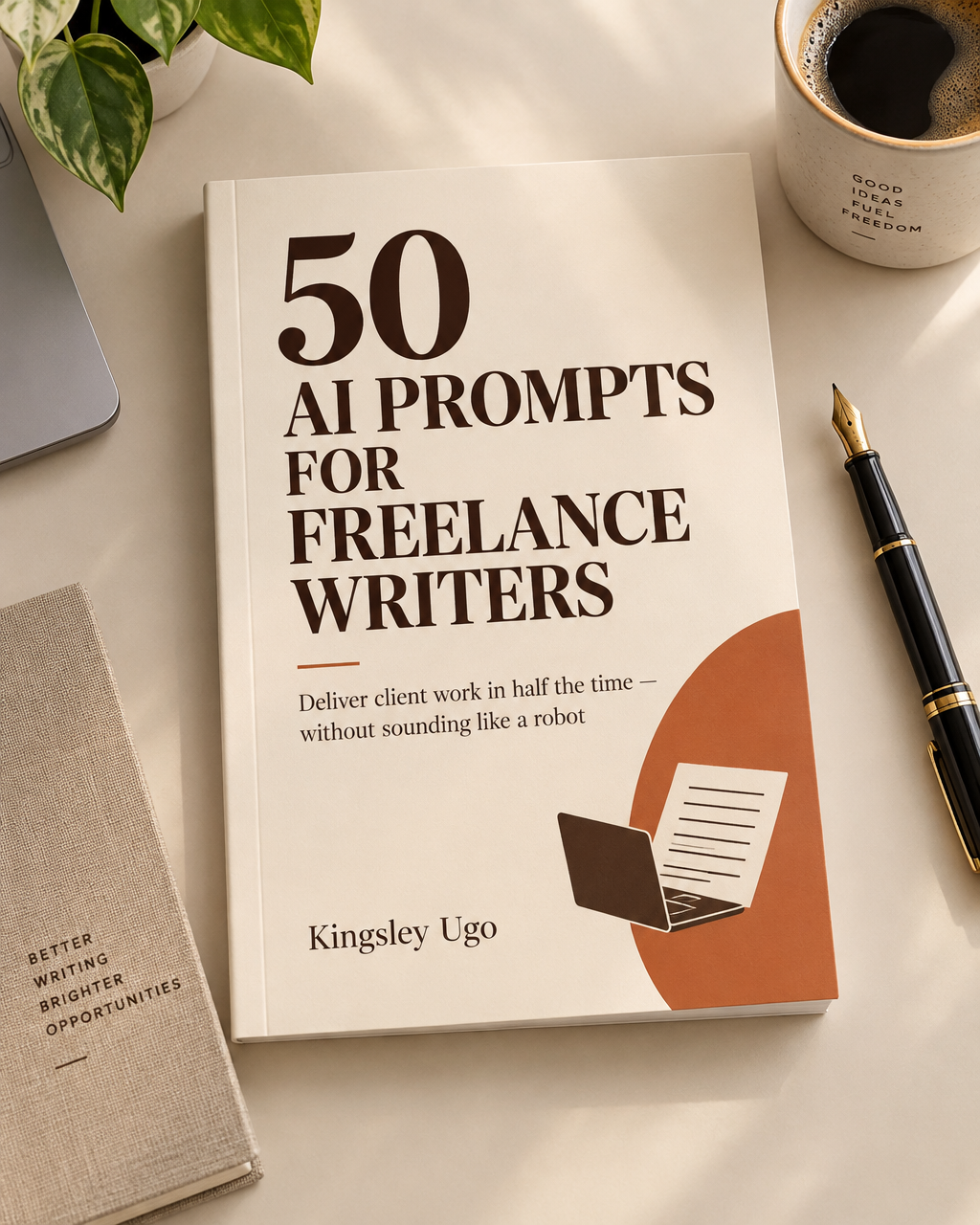
I wrote every prompt that worked into one file so I wouldn’t have to start over every time. Then I realized other freelance writers — especially beginners — were stuck exactly where I was: tired, underpaid, and told to “just use AI” by people who never had to fix the drafts.
So I turned that file into a proper guide. Every prompt in it includes when to use it and a real before-and-after example, so you can see the difference, not just the instructions.