For freelance writers who are tired of rewriting AI drafts
I Almost Quit Freelance Writing. Then I Changed How I Used AI.
The 50 tested prompts I now use for research, drafts, editing and pitching — so client work gets done in half the time and still sounds like me, not a robot.
Normally $10. Launch price ends October 31, 2026.

It was almost midnight and I was still on my laptop, rewriting a client’s article for the third time.
I’m a freelance writer in Nigeria. When I started, I took whatever work I could find, because I didn’t know how to find better clients or how to work faster. Some nights I stayed up late and still felt behind.
I tried AI because I was tired. At first the results were bad. Everything sounded generic, and clients could tell. I almost gave up on it.
What changed was the prompts. I started telling AI who the reader was, what voice to use, and what to cut. I tested, rewrote and saved the ones that worked — and my drafts started to sound like me again.
I didn’t learn this from a guru. I learned it by testing prompts on real writing tasks until the output sounded like me.
Sound familiar?
- You spend hours on client work that pays little — while everyone keeps telling you to “just use AI.”
- Every time you try, the draft comes out flat and generic. Clients notice, and you end up rewriting it anyway.
- So you save no time, your evenings disappear, and your confidence takes the hit.
What I tried that didn’t work
Generic “write me an article” prompts
Flat, robotic drafts that clients flagged immediately.
Copy-pasting AI output
Fast to produce, faster to lose the client.
Rewriting every draft by hand
Cancels out all the time AI saved. I did it for weeks.
Generic prompt lists
Not written for your voice or real client work, so they never fit.
The method behind every prompt in the guide
Give AI three things before you ask for anything
- 1
Your voice
Paste a sample of your own writing and tell AI to match it — short sentences, concrete details, no corporate filler.
- 2
The reader
Who they are and what they care about. This is what keeps the draft out of generic territory.
- 3
A rule for what to cut
My favorite: if a sentence could appear on any blog about any topic, cut it.
Then use one tested prompt for each stage of client work — research, draft, edit, pitch. Here’s a filled-in example of the voice-matching rewrite:
You are helping me rewrite a paragraph for a client blog post.

My voice, from my own writing:
"I'm a freelance writer in Nigeria. When I started, I took
whatever work I could find, because I didn't know how to
find better clients or how to work faster. Some nights I
stayed up late and still felt behind.

I tried AI because I was tired. At first the results were
bad. Everything sounded generic, and clients could tell."
Match the short sentences and concrete details. No
corporate filler.

The reader: freelance writers finishing client work after
a day job who want to save time without losing their voice.

Cut rule: if a sentence could appear on any blog about
any topic, delete it.

Now rewrite this paragraph:
"Freelance writers should leverage AI tools to optimize
their content creation process and increase productivity.
By integrating AI into their workflow, they can produce
high-quality articles efficiently and achieve better
client outcomes."
Example rewrite
If you finish your day job and still have a client article waiting, a blank page can eat your whole evening. Give AI the brief, a sample of your writing and a clear idea of who will read it. You still have to edit the draft, but now you’re fixing a few weak lines instead of starting over at midnight.
What the first month looked like
Within 15 minutes
Rewrite one real paragraph in your own voice using the voice-matching prompt.
First week
Use the research and drafting prompts on one real client job.
Weeks 2 to 4
Add the editing and pitching prompts and follow the weekly routine in Chapter 7.
What’s inside the guide
50 prompts across 7 chapters. Every prompt includes when to use it and a before-and-after example, so you can see the difference, not just the instructions.
- Ch 1Using AI in your own voice and your client's brand voice
- Ch 28 research and brief prompts
- Ch 310 blog and article prompts
- Ch 48 website and sales copy prompts
- Ch 58 editing and polishing prompts
- Ch 68 pitch and proposal prompts
- Ch 78 pricing and workflow prompts, plus a weekly routine
Plus two bonuses, free with the guide
10 Pitch Email Templates
Ready to adapt for Upwork, LinkedIn and cold outreach.
Client Onboarding Questionnaire
Get the details you need before you write a word.
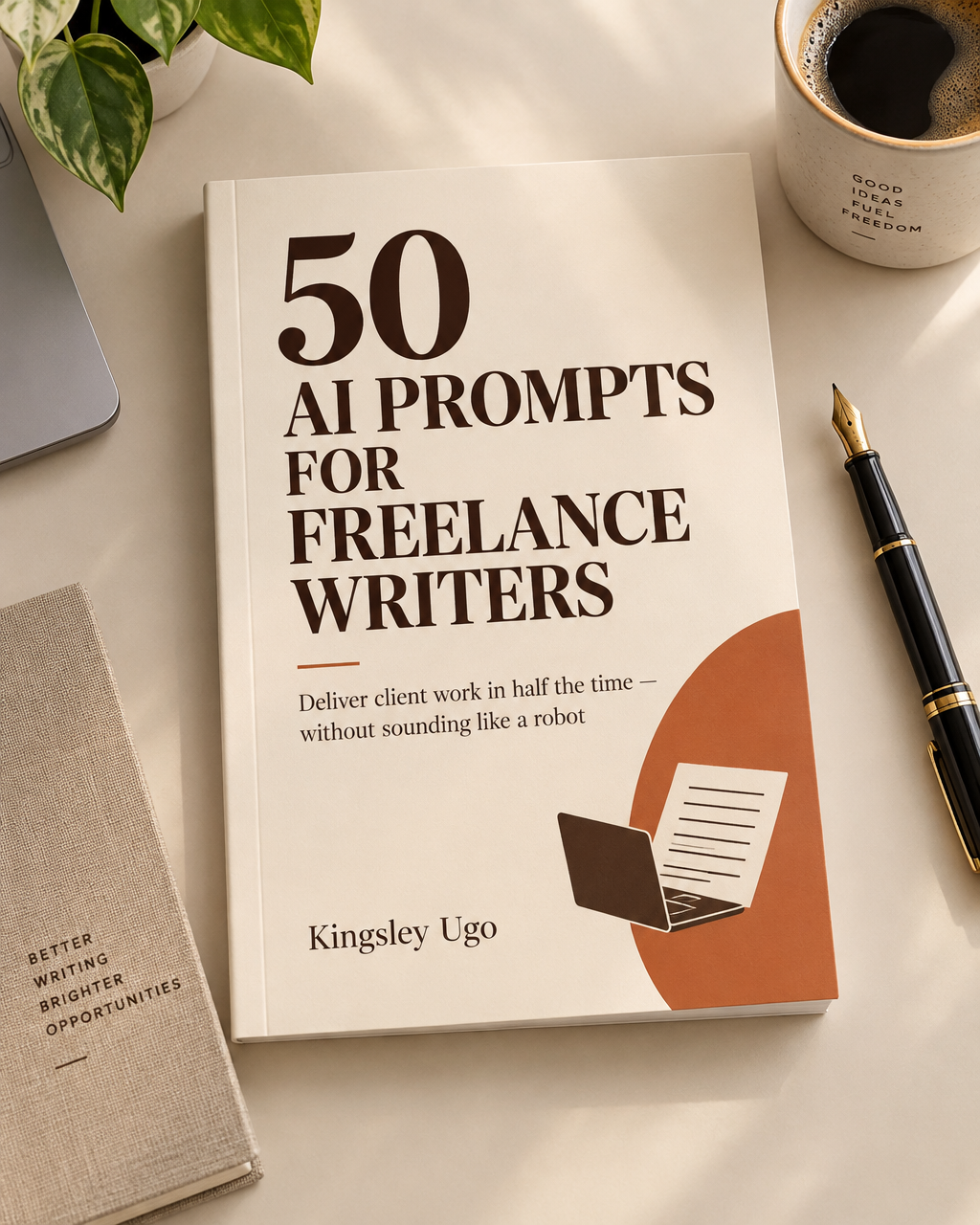
50 AI Prompts for Freelance Writers
Deliver client work in half the time — without sounding like a robot
$5
One-time payment. Yours to keep and reuse on every client job.
Get the guide nowLaunch price of $5 runs until October 31, 2026 — after that the guide is $10.
This was made for you if
- You're a beginner or mid-level freelance writer on Upwork, Fiverr, LinkedIn or working with direct clients.
- You have a day job and limited time, so every saved hour matters.
- You want to deliver client work faster — without it sounding like AI wrote it.
- You're tired of staying up late fixing flat AI drafts.
Stop rewriting AI drafts at midnight.
Start with the voice-matching prompt tonight — it takes fifteen minutes, and you’ll know immediately whether this changes things for you the way it did for me.
$10 after October 31, 2026.